There I was, cruising down the inside lane of a surprisingly quiet section of motorway. And there IT was, a rapidly-looming pothole, visible now as the car ahead straddled and cleared it. Did I brake instinctively? I don’t know. But I clearly turned the wheel to avoid it a little too rapidly and the next thing I knew I was turning it rapidly back to correct my trajectory. A few seconds later I was back on track. I’d avoided the pothole, but the car had helpfully performed a little shimmy, taking my body with it.
Or maybe it wasn’t the pothole? Maybe the previous weekend had laid the groundwork? The afternoon of bending, twisting and lifting, dragging and pruning of fallen branches the size of small trees, following substantial wind damage to the giant sequoia we play temporary custodian to.
Then again, maybe it was my history of ‘back niggles’ that laid the groundwork. These things rarely develop in isolation.
Whatever, the morning after my shimmy, the pain of rolling sideways out of bed was excruciating. I haven’t had back pain like it for a very long time. Pain that was later summarised to me as ‘a whiplash-type injury in the lumbar spine’.
Learning the hard way
It was many years ago that a physiotherapist, during treatment for back pain, used the term ‘occupational scoliosis’. My early career as an illustrator, my customary working posture hunched over a drawing board, left leg curled under me to hitch my drawing hand into its optimum ‘drawing’ position — had silently created a lateral S-shaped curving of my spine — hitching my right hip, lengthening on the left at my waist, then ‘winging’ my right scapula before straightening out again at the neck.
With the drawing board consigned to dusty retirement in the garage, hours of mouse-clicking, whilst slightly off-set to the right, have also exacerbated things in that right shoulder blade.
But — here’s the good bit — that same physiotherapist encouraged me first to Pilates, then into yoga and, from there into yoga teaching. And the thing about yoga teaching is you learn to listen to and work with your own body — all the better to help others do the same.
“You can’t go back and change the beginning, but you can start where you are and change the ending.” C S Lewis
We humans are very adept at slapping ‘labels’ on ourselves, then weaponising them as reasons ‘not to’ and it took me a long time to address my own tendency to do just that.
My philosophy now (as a teacher and in my own practice) is one of exploration, of ‘can do’ rather than ‘can’t’. You invoke the ‘age’ word in my classes at your peril. It fascinates me how empowering this is – the look (and sometimes squeal) of delight when someone realises they have achieved a range of movement or posture they didn’t think possible. I’m not talking extreme poses here, just the ‘perceived’ range of movement we might have lost through injury or lack of use over time (this the most malevolently insidious). This might be as simple as lifting an arm above shoulder height, crossing one leg over the other, or bending to one side without leaning forward. Or standing on one leg. Things we all take for granted until we reach for them one day and realise they’re no longer accessible. Our brain, in its wisdom, has decided we no longer have need for them.
Rather than viewing that lack of movement as an ‘inevitable’ symptom of ‘getting older’, I’d always encourage gentle exploration.
Often it’s the fear of what might happen when we make those moves that holds us back from trying — the memory of a once-felt pain (often years after any acute stage). Or that feeling of wobbling insecurity as our brain recalibrates our balance, or the idea we might look less accomplished than our peers. Or simply fear of how our body has changed. And sometimes, of course, we actually have poked a long-forgotten weak spot.
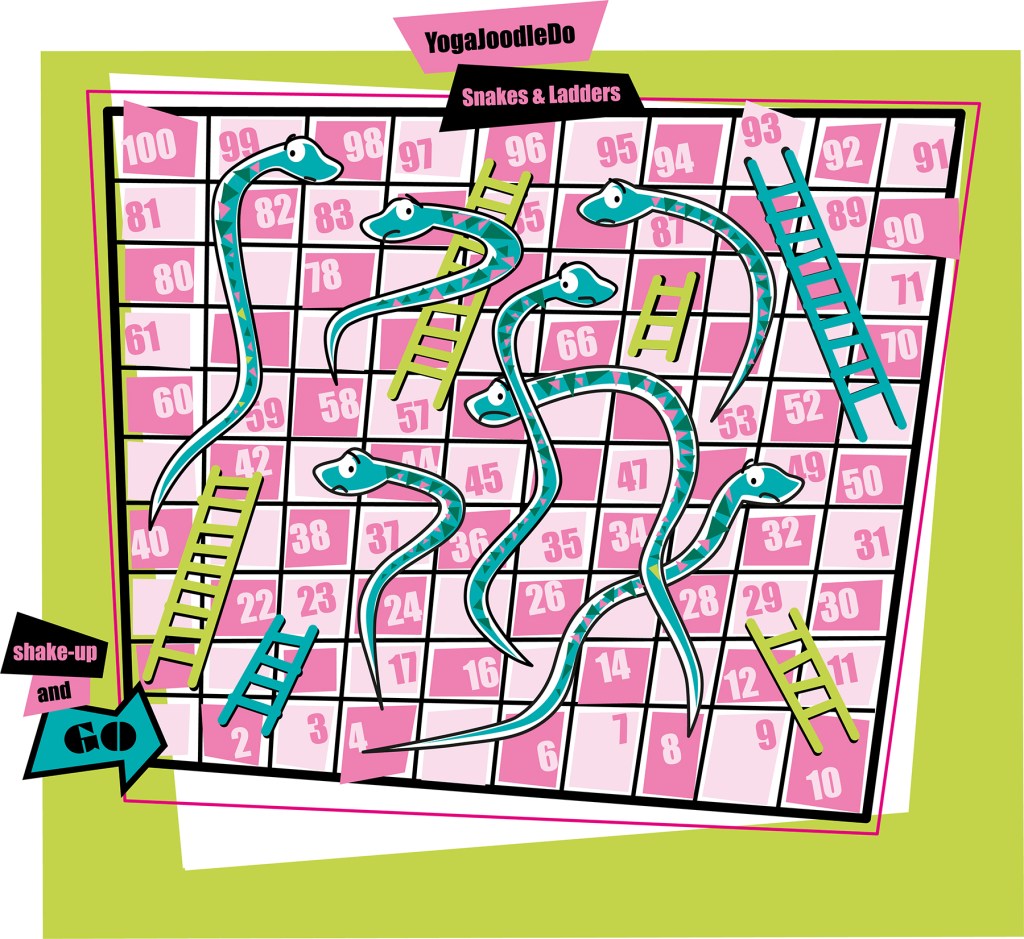
Snakes and Ladders anyone?
Without question, the experience has tested me. The spectre of age and infirmity, the mental labels hovering oh so close, cut and paste reasons my future self ‘can’t do’.
So I get it, I really do. More so now than ever. But therein lies a very slippery slope, because the more we succumb to the ‘labels’, the less movement we find, the less movement will become available to us.
I’ve had flare-ups over the years — albeit none quite so severe — and I’ve needed hands-on help alongside a prescribed rehabilitation programme and my own practice. And what I’ve learned — the hard way — is that the body is very good at clinging on to old patterns, particularly under stress.
The first thing I did was see a physio for assessment, hands-on treatment and rehabilitation advice, subsequently finding (and frequently losing again) the patience to allow inflammation to subside, then slowly rebuilding the exercise programme to restore strength.
‘Like a game of Snakes and Ladders’ is the best analogy I can think of. Despite the general trajectory being up, one day I’d be climbing a metaphorical ladder, euphoric with the absence of discomfort, the next slithering helplessly back down a snake to sob-inducing pain and frustration. Only thing to do was navigate my way upwards again.
Breathing through it
For the first three weeks, my body refused to allow very much movement without pain (actual, not perceived), so I focused on my breathing.
First, four rounds of ‘Wim Hof‘ (thirty rolling deep breaths, in through the nose, into the belly, filling the lungs then out through the mouth, followed by a breath hold until I feel the urge to breathe again), to ‘stimulate the parasympathetic system to bring stress levels down’ and ‘reduce inflammation’.
Then ten to twenty minutes of coherent breath (rhythmic breathing in a 6:6 pattern, focusing on the belly and heart centre) which, according to Stephen Elliott, author of The New Science of the Breath, ‘promotes optimal circulation, improving brain function and nourishing every cell in the body’.
When all else failed, this was a constant. Sometimes relief lasted moments, sometimes hours. How much was down to a natural healing cycle, how much was mind over matter and how much changing the pattern of my breathing impacted my body chemistry, it’s hard to know. But I’ll take the fact that there was some relief —and I felt engaged in my own healing process.

In summary: Here’s what I have learned
I’m not talking about bone breaks and blunt trauma injuries here, but the aches and pains and twinges we all gather along the way, to varying degrees of debilitation.
1. Head straight to your physical therapist of choice — it’s worth every penny and every moment in what might be a long, impatient process, to get yourself assessed by someone who can read your body and its alignment. Don’t wait. Because waiting might see the pain go away, but not before — like a silent, sneaky ninja — it has set up movement and mindset which might not serve you in the long term.
2. Take them seriously when they give you those exercises — ask them to go through them with you, so you know you’re doing things correctly. Or not. That way, you’ll have some awareness of how easy it is to ‘cheat’. Our bodies are really, really good at letting us think we’re moving one set of muscles, even entire limbs, in one direction, when all we’ve done is rallied the surrounding troops to do the work instead and headed off in another direction entirely. Don’t just toss those exercises into the long grass of your memory, wondering all the while why things aren’t improving. Because YOU need to put the effort in.
The reverse is also true. If they advise you to rest or not move in a particular way just yet, then do as they suggest. Your body will very quickly let you know it isn’t happy, but that doesn’t mean it is beyond hope. It just means it’s still healing. Patience, young Grasshopper*. How much better will you feel when you emerge from this, knowing YOU engaged in your own rehabilitation, strengthening and protecting your body from future episodes in the process?
3. Resist the temptation to consult Doctor Google, because the Wheels of Doom whirl at speed in a worried, pain-addled brain. Especially after dark. Back pain can indeed be a symptom of many a truly scary diagnosis but, to quote the NHS ‘very rarely’ is it a sign of a ‘serious problem such as a broken bone, cancer or an infection’.
4. Breathing. Of course. In its most acute stage, I could barely move through even a couple of repetitions of the prescribed exercises. And then, once I could, it would set off a new inflammation. I’d think I was getting somewhere only to slide back into pain. So rather than push on through the pelvic tilts, I just used my breath, inflating the belly with my inhale and imagining my exhale lengthening my lumbar spine (rather than actually moving the pelvis), and softening those areas of tension.
5. Progress isn’t linear. When first we find ourselves in pain, we might fondly imagine that the recovery line on our personal ‘graph’ will curve smoothly, effortlessly — and no doubt rapidly — upwards, as its painful opposite number curls equally rapidly down and out (of sight and memory). Oh how I wish this were so.
“Believe you can, and you’re halfway there.” Theodore Roosevelt
It might be that your body isn’t ready for those movements just yet. But it will be. The body wants to move. It needs to move. As in yin yoga, learn to explore your ‘edge’. Find that point when you feel a resistance in the body, your edge of comfort. Some days that edge might mean less movement than the day before. So rewind to the start point and begin again.
Coming back to the idea of perceived versus actual pain, ‘the push or not into pain is a big discussion’, says Sarah Lord, a physiotherapist and wellbeing coach. ‘Yes, in the acute scenario it may be a so-called danger message but, especially as things become more persistent, it may just be memory and prediction rather than an accurate threat message, so the thing is to work with it rather than avoid. Pain doesn’t necessarily mean or equal harm’.
For me, it has been about finding a balance between two very powerful forces: fear and ego. The fear that held me back from exploration and movement because ‘it might hurt’, versus my irrepressible ego urging me to keep on pushing through the pain rather than accept this temporary fragility! I’m guessing the same is true for everyone.
Or maybe you’re making progress, life has returned to a pain-free sense of ‘normal’, then a sudden move — and there it is again. Maybe not as acute as before, but now you’re slithering back down that snake. Wondering perhaps whether you will EVER make it back up the board, whether it’s worth the effort. Maybe this is just ‘how you are now’. Same applies. Take a breath. In fact, take a few. Make them coherent (see earlier). Then rewind once more to the start point and begin again.
6. Find things you CAN do. Definitely not at the start, but as my back began to move more freely and the discomfort became less all-consuming, I started exploring how I could move and strengthen other bits of the body: hamstring stretches at one end and shoulder mobility at the other. A bit of standing balance practice. And walking in a mindful posture, however short the distance. Gradually finding my way back to my own yoga practice. And breathing. Always breathing.
And never forget that, to paraphrase CS Lewis, you might not be able to go back and change the beginning, but you can always start where you are and change the ending.
Footnote: *Those of a certain generation (ie. younger!) might not get the ‘young Grasshopper’ reference. It’s the classic line Master Po repeats (often) to the young Kwai Chang Caine, played by David Carradine, in the 1970s show ‘Kung Fu’. Required late-Saturday afternoon watching back then. A swift Google search will throw up any number of blurry clips.
 YogaJoodleDo